
Styrene Isoprene Styrene Block Copolymers (SIS) were co-developed by Phillips Petroleum and Shell Chemical in the 1960s and experienced further development in the 1970s.
Due to its exceptional corrugated sealing performance and high-temperature retention, SIS is uniquely suited as an adhesive and is commonly formulated with SBS or other materials. Its core applications lie in pressure-sensitive adhesives (PSA) and hot-melt adhesives (HMA), widely utilized in medical, electrical insulation, packaging, protection/masking, labeling, bonding fixation, and composite bag lamination. Hot-melt pressure-sensitive adhesives are solvent-free, eco-friendly, low-energy, compact in equipment requirements, and broad in bonding scope, with growth rates exceeding that of SBS in recent years.
Major SIS Companies
| Manufacturer | Brand / Grade |
| TSRC Specialty Materials LLC | Vector |
| Versalis (Eni Group) | Europrene SOL T |
| Kraton Corporation | Kraton D / G / FG |
| Zeon Corporation | Quintac |
| Sinopec Baling Petrochemical Company | Sinopec YH |
| LCY Chemical Corp. | GLOBALPRENE SIS |
1. Core Industrial Production Methods
The industrial synthetic routes of SIS originate primarily from the technological foundations of Phillips and Shell, categorized mainly into the three-step feeding process and the coupling process:
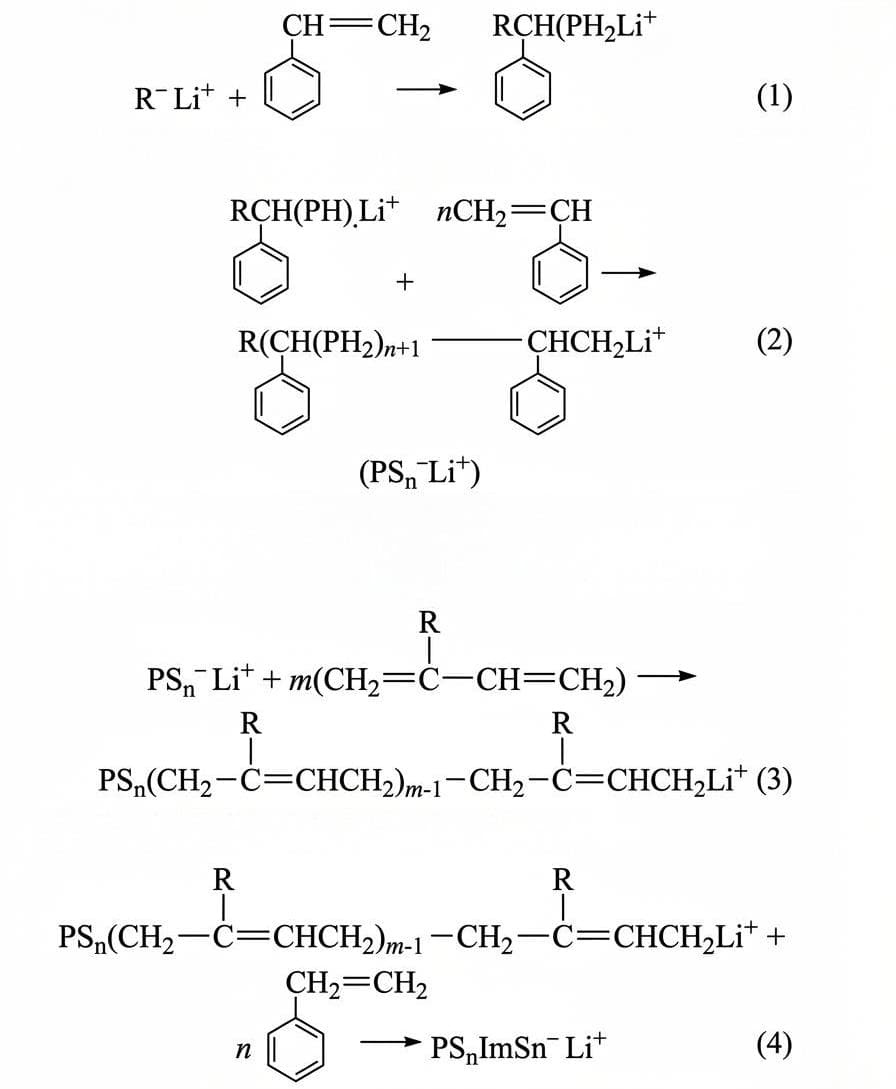
Three-Step Feeding Process:
Using cyclohexane as a solvent, η-butyllithium or sec-butyllithium as an initiator, and tetrahydrofuran as an activator. The initiator first reacts with styrene monomers to form active (PS) Li chains, followed by the addition of isoprene monomers for the second-stage polymerization, and finally styrene monomers for the third-stage polymerization to yield linear SIS. This process yields a relatively narrow molecular weight distribution, but multiple feeding steps can easily introduce impurities, generating diblock copolymers (PSI) that adversely affect product performance.
Coupling Process:
The first two polymerization steps are identical to the three-step method, with the final step introducing a difunctional or multifunctional coupling agent (such as SiCl4) for the coupling reaction. Multifunctional coupling agents yield star-shaped block copolymers. However, due to the steric hindrance of the polyisoprene blocks, the coupling degree and efficiency tend to be lower, resulting in a higher content of PSI diblocks.
2. Global and Domestic Industry and Application Status
2.1 Global Industry and Application Structure
The production difficulty of SIS is higher than that of SBS; although many global SBS plants have swing-production capabilities, their dedicated grades are significantly fewer than those of SBS. In 2002, global SIS production capacity was approximately 350 kt/a, with an output of about 250 kt. In terms of downstream applications, significant regional differences exist: 80% ~ 90% of SIS in the United States is consumed in adhesives (especially HMPSA); over 90% of Japanese-produced SIS is used in adhesives; whereas in Europe, SIS consumption is constrained by the supply of high-purity isoprene monomers.
2.2 Domestic Supply-Demand, Application Prospects, and Recommendations
Research and development of SIS in China started relatively late, primarily constrained by upstream C5 fraction separation technologies. In recent years, enterprises represented by Baling Petrochemical have achieved technological breakthroughs, launching grades such as SINOPEC SIS YH-1105 and SINOPEC SIS YH-1106 to drive import substitution. In terms of application markets, the core momentum for domestic SIS stems from the rapid growth of hot-melt adhesives and HMPSAs (e.g., labels, tapes, women's sanitary napkins, and baby diapers).
To foster future growth, industry experts recommend:
Vigorously Develop and Utilize C5 Resources: Enhance the comprehensive utilization rate of C5 fractions in domestic ethylene units to secure a stable supply of high-grade isoprene monomers.
Accelerate the Development of High-End and Upgraded Products: Learn from global technology trends to expand application scenarios in high-end adhesives and specialty elastomers.
As an indispensable high-performance elastomer matrix in modern pressure-sensitive and hot-melt adhesive formulations, SIS thermoplastic block copolymers play a pivotal role in the eco-friendly adhesive market. With the continuous improvement of the domestic C5 industrial chain and ongoing breakthroughs in polymerization processes and modification technologies, the SIS industry is poised for broader development horizons in green packaging, medical hygiene, and high-end manufacturing.
Website: www.elephchem.com
whatsapp: (+)86 13851435272
E-mail: admin@elephchem.com



 Soporta red IPv6