
Selvol PVOH 205 Es una resina de alcohol polivinílico de baja viscosidad, parcialmente hidrolizada. En química industrial, elegir el grado exacto de resina —en lugar de simplemente la categoría genérica del polímero— es crucial para la estabilidad de la formulación, la eficiencia del proceso y el rendimiento de adhesión final.
1. Especificaciones técnicas y características principales
Selvol PVOH 205 se caracteriza por su estructura molecular equilibrada y sus propiedades físicas específicas:
| Parámetro clave | Especificación | Impacto técnico |
| Grado de hidrólisis | 87,0–89,0 % molar (~88 % molar nominal) | Deja grupos acetato residuales en la cadena principal del polímero, lo que aumenta la actividad superficial, la flexibilidad y la compatibilidad con sustratos hidrofóbicos. |
| Viscosidad (solución acuosa al 4% a 20 °C) | 5,2–6,2 cP | El bajo peso molecular garantiza una baja carga reológica, una alta capacidad de bombeo y una rápida disolución incluso a concentraciones elevadas de sólidos. |
| Rango de pH de funcionamiento | 4,5–6,5 | Produce soluciones acuosas claras y estables en condiciones de formulación estándar. |
| Variantes de producto | Granulado estándar y polvo fino | Su formato de polvo fino permite una mezcla en seco perfecta en formulaciones cementicias y de yeso. |
| Cumplimiento normativo | Cumple con las regulaciones de contacto con alimentos de la FDA y del BfR. | Adecuado para aplicaciones de contacto indirecto con alimentos, incluidos adhesivos para papel y embalaje. |
Principales ventajas de su formulación frente a los grados totalmente hidrolizados.
En comparación con los grados de PVOH totalmente hidrolizados (como PVA 098-03), Selvol PVOH 205 ofrece importantes ventajas en cuanto a procesamiento y rendimiento:
Mayor actividad superficial y capacidad emulsionante: Los grupos acetilo residuales le confieren propiedades anfifílicas, lo que lo convierte en un excelente coloide protector y emulsionante.
Mayor flexibilidad de la película: Forma una película seca más suave y no quebradiza, con mayor elongación y menor agrietamiento por tensión en comparación con las películas rígidas totalmente hidrolizadas.
Mayor adhesión al sustrato: Demuestra una fuerte adherencia y fijación a sustratos no polares, sintéticos o celulósicos.
Temperaturas de disolución más bajas: Se disuelve más rápidamente a temperaturas más bajas, lo que reduce el consumo de energía durante la preparación de lotes industriales.
2. Aplicaciones industriales
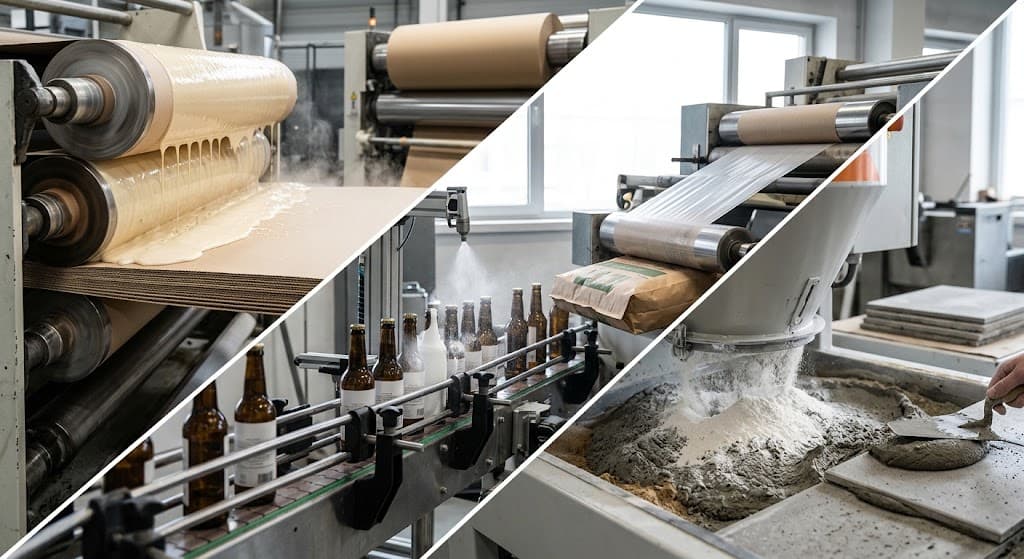
Adhesivos para la conversión de madera y papel
Función: Actúa como coloide protector durante la polimerización en emulsión de Acetato de polivinilo (PVAc).
Problema resuelto: Evita la separación de fases de la emulsión de PVAc, mejora la estabilidad ante ciclos de congelación y descongelación, prolonga el tiempo de apertura y aumenta la adherencia inicial.
Usos principales: Laminación de cartón multicapa, bobinado de tubos de papel, adhesivos para muebles y canteado.
Adhesivos para embalaje y etiquetado
Función: Agente de encuadernación y aplicación de adhesivo principal en sistemas de etiquetado y laminación de alta velocidad.
Problema resuelto: Mejora la adherencia en húmedo sobre vidrio y plástico, evita el amarilleamiento/opacidad de la película gracias a su alta estabilidad a la luz y garantiza un mecanizado limpio a alta velocidad.
Usos principales: Etiquetado de botellas de vidrio/plástico, etiquetas autoadhesivas, bolsas de papel multicapa y laminación de películas flexibles.
Emulsiones para la construcción y polvos redispersables
Función: Coloide protector en polvos poliméricos redispersables (PPR) secados por pulverización.
Problema resuelto: Evita que el polvo se apelmace durante su almacenamiento y garantiza una rápida redispersión al añadir agua en la obra, lo que contribuye directamente a la resistencia a la tracción de las matrices de mortero.
Usos principales: Adhesivos para baldosas, capas base autonivelantes, sistemas EIFS y morteros de mezcla seca (que utilizan polvo fino Selvol E 205).
Sistemas adhesivos rehumectables
Función: Formador de película reactivable con agua.
Problema resuelto: Forma películas secas no pegajosas que se reactivan de forma rápida y uniforme al humedecerse de nuevo, eliminando puntos fríos o huecos en la unión adhesiva.
Usos principales: Adhesivos para solapas de sobres, sellos postales y cintas de embalaje engomadas activadas por agua para la logística del comercio electrónico.
Papel especial y recubrimientos de barrera
Función: Coaglutinante y agente de barrera contra aceites y grasas.
Problema resuelto: Su baja viscosidad permite operaciones de recubrimiento a alta velocidad sin picos de viscosidad; crea una densa barrera unida por enlaces de hidrógeno contra la grasa, los aceites y el oxígeno.
Usos principales: Recubrimientos protectores para papel térmico, capas barrera para papel autocopiativo y cartón para envases de alimentos resistente a la grasa.
Encolado de urdimbre de textiles sintéticos
Función: Agente de encolado protector formador de película para hilos sintéticos y de mezcla.
Problema resuelto: Una mayor adhesión a las fibras hidrofóbicas de poliéster/nylon evita el desprendimiento de fibras y la rotura de hilos durante el tejido a alta velocidad; una menor cristalinidad permite un desencolado limpio con agua caliente.
Usos principales: Encolado de filamentos, encolado de hilos hilados de poliéster-algodón y aplicaciones de aglutinantes para telas no tejidas de formación húmeda.
Aglutinantes especiales y recubrimientos industriales temporales
Función: Aglutinante transitorio y formador de película sacrificial.
Problema resuelto: Proporciona resistencia estructural temporal antes de la eliminación completa mediante combustión o enjuague con agua, sin dejar residuos.
Usos principales: Aglutinante cerámico para cuerpos verdes (alúmina/circonia), recubrimientos protectores despegables, cápsulas de microencapsulación y películas de detergente en dosis unitarias.
Sitio web: www.elefante.com
WhatsApp: (+)86 13851435272
Correo electrónico: admin@elephchem.com



 Soporta red IPv6