
En el mundo de la conservación arqueológica, proteger los artefactos cerámicos en climas cálidos y áridos es una lucha constante contra la naturaleza. Sin instalaciones de almacenamiento con temperatura controlada, los adhesivos estándar de calidad museística suelen fallar. Cuando la temperatura ambiente iguala o supera la temperatura de transición vítrea (Tg) de un polímero, el adhesivo, antes sólido, se ablanda, dando lugar al temido fenómeno conocido como "deformación por frío" o colapso estructural.
Durante décadas, el Paraloid B-72 ha sido el material predilecto de los conservadores de cerámica debido a su excelente reversibilidad y flexibilidad. Sin embargo, su Tg es de tan solo 40 °C. En excavaciones en el desierto o en laboratorios de campo sin refrigeración, las temperaturas pueden superar fácilmente este umbral, lo que provoca la inestabilidad del B-72 puro.
Eastman PVB Butvar B-98: El modificador de alta temperatura
Para solucionar este problema, los investigadores han estudiado la mezcla de polímeros para elevar la Tg efectiva. Si bien se han utilizado mezclas tradicionales como Paraloid B-48N y B-72, estas suelen presentar una liberación lenta del disolvente y una menor resolubilidad.
Un estudio reciente destaca una alternativa prometedora: Butvar B-98 (un butiral de polivinilo Copolímero de PVB). Con una robusta Tg individual de 72-78℃, el B-98 se está evaluando como modificador para reforzar el Paraloid B-72 en climas extremos.
Rendimiento: Resistencia vs. Compatibilidad
La investigación sometió a pruebas rigurosas diversas proporciones de mezcla B-98/B-72 (1:3, 1:1 y 3:1). Esto es lo que revelan los datos analíticos:
Durante las pruebas de cizallamiento, el Butvar B-98 puro superó a todas las demás opciones. Más importante aún, la adición de B-98 al B-72 mejoró significativamente el rendimiento del adhesivo. La mezcla 3:1 de B-98:B-72 alcanzó el módulo de Young y la carga de fluencia más altos entre las mezclas, demostrando ser mucho más eficaz para aumentar la capacidad de carga que las modificaciones tradicionales de B-48N.
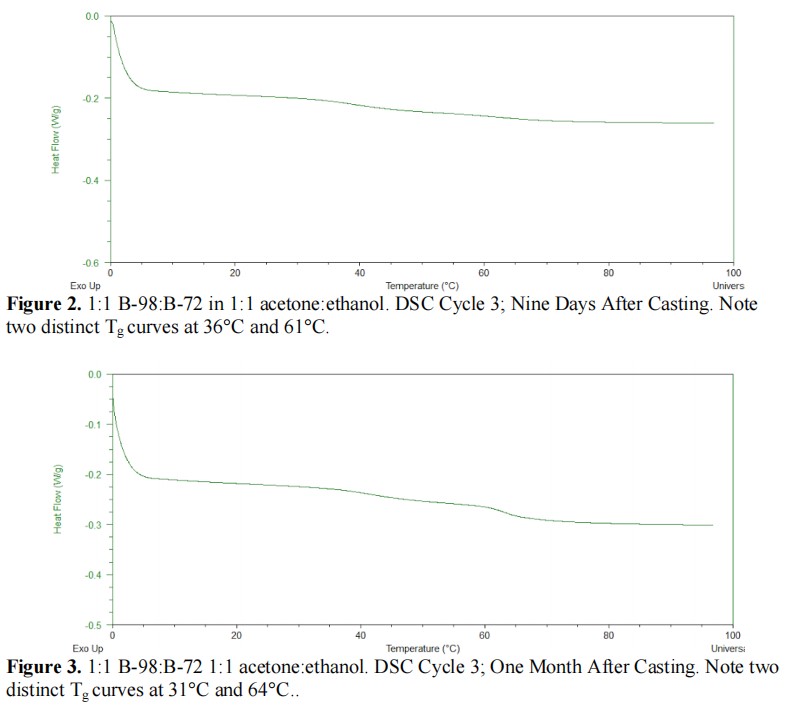
La calorimetría diferencial de barrido (DSC) confirmó que el B-98 elevó con éxito el umbral de Tg, lo que significa que las mezclas tienen mucha menos probabilidad de colapsar en un entorno caliente. Sin embargo, los datos también revelaron una peculiaridad fascinante: la inmiscibilidad. Con el tiempo, a medida que el disolvente se evaporaba, las mezclas de B-98 y B-72 comenzaron a separarse en fases. Herramientas analíticas como la espectroscopia FTIR de transmisión y la microscopía óptica revelaron la formación de distintas "fases interior y exterior" circulares dentro de la película seca, donde una fase concentraba más B-72 y la otra más B-98.
Consejos prácticos para los conservadores
¿Qué significa esto para la conservación del medio ambiente?
Mayor resistencia a altas temperaturas: si trabaja en entornos que superan los 40 ℃, mezclar Butvar B-98 con su configuración de Paraloid B-72 proporcionará a la unión una defensa térmica y una resistencia estructural mucho mayores que si se utilizan alternativas puras de B-72 o B-48N.
Cuidado con el disolvente y la separación: porque los dos polímeros (Resina de butiral de polivinilo) no se fusionan completamente en una sola fase, su rendimiento depende en gran medida de la dinámica del disolvente. Usando una mezcla de disolventes optimizada (como acetona y etanol), y controlar la velocidad de secado es esencial para evitar la acumulación prematura o la cristalización desigual de la película.
La mezcla de Butvar B-98 y Paraloid B-72 representa un gran avance para superar las limitaciones de las pinturas acrílicas a altas temperaturas. Ofrece una opción más resistente y estable para proteger nuestro patrimonio común en un entorno donde el calor es constante.
Sitio web: www.elephchem.com
WhatsApp: (+)86 13851435272
Correo electrónico: admin@elephchem.com



 Soporta red IPv6