
La emulsión de polímero VAE es una emulsión de copolímero de acetato de vinilo y etileno. Debido a la introducción del comonómero etileno, su plasticidad interna mejora significativamente. Por lo tanto, la emulsión de polímero VAE tiene buenas propiedades de formación de película, baja temperatura de formación de película, recubrimiento suave y fuerte, y resistencia al desgaste, mejorando así significativamente la resistencia al agua, la resistencia a los álcalis, la resistencia a la intemperie y la resistencia a las manchas del recubrimiento. Elegir una Emulsión VAE (emulsión de copolímero de acetato de vinilo y etileno) Su menor viscosidad permite incorporar una gran cantidad de relleno manteniendo una excelente adhesión a diversos sustratos. Esta propiedad única lo hace ideal para materiales adhesivos donde el relleno se utiliza para controlar la fuerza de unión y el costo.
1. Preparación de recubrimientos impermeables
Según los requisitos técnicos de la obra, se añaden a la emulsión VAE aditivos adecuados como estabilizadores, dispersantes y antiespumantes. Asimismo, se seleccionan polvos como cemento, carbonato de calcio y cuarzo en polvo para diseñar diversos revestimientos impermeables que cumplan con los distintos requisitos técnicos.
1.1 Recubrimiento impermeable JS
Los recubrimientos impermeables JS de dos componentes a base de agua, compuestos principalmente de emulsión de polímero y cemento, se presentan en dos tipos: uno utiliza cemento exclusivamente como relleno, y el otro utiliza una mezcla de cemento y otros polvos como relleno. Ambos tipos de recubrimientos impermeables JS forman sus películas principalmente mediante la hidratación del cemento y la deshidratación y fusión de las partículas de polímero. Sin embargo, debido a la diferencia en los rellenos, sus propiedades de película difieren. El diseño de una formulación que cumpla con las normas y los requisitos de ingeniería generalmente utiliza la relación polímero-cemento (P/C) como parámetro principal. Basándose en años de experiencia experimental, este artículo analiza la formulación utilizando cemento de aluminato y emulsión VAE como ejemplo, mediante datos y gráficos. La Figura 1 muestra la elongación a la rotura del recubrimiento con cemento como único relleno, en función de P/C; la Figura 2 muestra la elongación a la rotura del recubrimiento con una mezcla de cemento y polvo de cuarzo como relleno, en función de P/C. Ambos recubrimientos cumplen con los requisitos de resistencia a la tracción de la norma JC/T 894—2001.
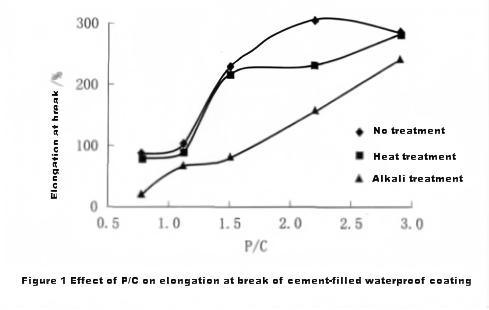

Según la norma JC/T 894—2001, el rango de valores del parámetro de diseño P/C que cumplen con los requisitos del índice de rendimiento de los recubrimientos impermeables JS de tipo I y tipo II se puede encontrar en las figuras 1 y 2, resumidas en la tabla 1.
| Tabla 1. Parámetros de diseño del rango de valores P/C del recubrimiento impermeable JS | ||
| Tipo de relleno | Recubrimiento impermeable tipo I JS | Recubrimiento impermeable tipo II JS |
| Cemento | 1.9-2.8 | 1.1-2.1 |
| Cemento + polvo de cuarzo | 1.8-2.6 | 1,5-1,8 |
Para los recubrimientos impermeables JS compuestos exclusivamente de cemento, la relación polímero/polvo (P/C) puede considerarse un parámetro de diseño. Sin embargo, para los recubrimientos impermeables JS elaborados mediante la mezcla de cemento y otros rellenos, además de la relación P/C, los parámetros de diseño también deben considerar la relación polímero/polvo (P/F, la relación entre la masa de polímero y la masa total de polvo) y la relación cemento/polvo (C/F, la relación entre la masa de cemento y la masa de los demás polvos). Los efectos de P/F y C/F sobre la elongación a la rotura de los recubrimientos impermeables con relleno parcial de cemento se muestran en las figuras 3 y 4, respectivamente.

Al comparar las figuras 3 y 4 con la figura 2, se aprecian claramente los efectos de P/F y C/F sobre la elongación a la rotura. Un aumento en el valor de P/F incrementa la elongación, mientras que un aumento en el valor de C/F la disminuye. Los puntos de cambio abrupto en las curvas de P/F, C/F y P/C son básicamente correspondientes. Por lo tanto, al diseñar recubrimientos impermeables JS, es necesario considerar exhaustivamente estos parámetros para obtener la proporción de mezcla óptima. En aplicaciones de ingeniería, se deben tener en cuenta los siguientes aspectos:
(1) Al tratar fisuras finas y reforzar las capas, añadir una capa de tela de fibra de vidrio a la película de recubrimiento puede mejorar notablemente su resistencia a la tracción. Los experimentos demuestran que, con los mismos parámetros de materia prima, añadir una capa de tela de fibra de vidrio puede incrementar la resistencia a la tracción de la película de recubrimiento en un 471 %, a la vez que reduce la elongación a la rotura en un 99 %.
(2) Cuando se requiere aumentar la elongación a la rotura de la película de recubrimiento, se puede agregar una cantidad adecuada de plastificante, pero esto resultará en una pérdida de resistencia a la tracción. Por ejemplo, utilizando la misma fórmula, agregar un 12 % de plastificante aumenta la elongación a la rotura de la película de recubrimiento en un 93 %, pero reduce la resistencia a la tracción en un 69 %.
(3) Al utilizar cemento para preparar recubrimientos impermeables JS, el ajuste de la fórmula con P/C generalmente implica que, a medida que P/C aumenta, la resistencia a la tracción de la película de recubrimiento disminuye, mientras que la elongación a la rotura aumenta. Sin embargo, este patrón se aplica dentro de un rango determinado de valores de P/C, y dicho rango varía según el tipo de cemento. Por lo tanto, es necesario determinarlo mediante pruebas de aplicación.
(4) La preparación de recubrimientos impermeables JS mediante polvos mixtos resulta relativamente compleja. El análisis de los datos de la Tabla 2 muestra que, cuando la relación P/F es la misma, la resistencia a la tracción y la elongación a la rotura de la película de recubrimiento no presentan diferencias significativas; sin embargo, cuando la relación P/C es la misma pero la relación P/F es diferente, el rendimiento de la película de recubrimiento también varía.
| Tabla 2. Efectos de P/C y P/F en el rendimiento del revestimiento impermeable | |||
| ORDENADOR PERSONAL | P/F | Resistencia a la tracción / MPa | Alargamiento a la rotura / % |
| 2.6 | 1.0 | 4.2 | 232 |
| 2.1 | 1.0 | 4.1 | 171 |
| 1.8 | 1.0 | 4.1 | 211 |
| 1.5 | 1.0 | 4.1 | 196 |
| 1.5 | 0.9 | 3.3 | 257 |
| 1.5 | 0.8 | 3.6 | 133 |
| 1.5 | 0.7 | 3.7 | 67 |
| 1.5 | 0,5 | 4.7 | 43 |
(5) Cuando se utilizan distintos tipos de cemento con emulsión VAE para preparar recubrimientos impermeables, incluso con los mismos parámetros de mezcla, las diferencias en el rendimiento de la película de recubrimiento siguen siendo significativas. Esto debe tenerse especialmente en cuenta en aplicaciones de ingeniería para evitar pérdidas innecesarias.
1.2 Recubrimientos impermeables de emulsión polimérica
Utilizando la emulsión VAE como materia prima principal, también se pueden preparar recubrimientos impermeables de tipo emulsión acuosa de un solo componente. Si se agregan pigmentos de color, la película de recubrimiento, además de su función impermeable, también tiene la función de embellecer el entorno. El diseño de la formulación y las pruebas de rendimiento muestran que el uso de la emulsión VAE en combinación con otras emulsiones mejora eficazmente la resistencia a la tracción y la elongación a la rotura de la película de recubrimiento, logrando mejores resultados que el uso de la emulsión VAE sola (como VINAVIL EVA 2606L) .
Con la misma proporción polímero-polvo (P/F), el recubrimiento impermeabilizante de emulsión compuesta presenta un rendimiento superior. Todos los indicadores son más adecuados y cumplen con los requisitos de la norma JC/T 864—2000 «Recubrimientos impermeabilizantes de emulsión polimérica para edificios». Cabe destacar que no se debe utilizar una única proporción de formulación en todos los proyectos; en su lugar, los tipos y cantidades de emulsión y polvo deben ajustarse según las áreas de aplicación reales para garantizar que el rendimiento del recubrimiento impermeabilizante cumpla con los requisitos de cada proyecto.
2. Preparación de agentes impermeabilizantes para mortero
La impermeabilización rígida comenzó con el método de enlucido de cinco capas, evolucionando gradualmente hacia el uso de aditivos para modificar el mortero de cemento o el hormigón, y actualmente hacia el mortero de cemento modificado con polímeros. En comparación con el mortero de cemento convencional, el mortero de cemento modificado con polímeros presenta numerosas propiedades superiores, como una fuerte adherencia, alta elasticidad, resistencia al impacto, buena impermeabilización y mayor resistencia química. La elevada fuerza de unión de la emulsión VAE la hace muy idónea para su uso en mortero de cemento modificado.
Al preparar agentes impermeabilizantes para mortero de cemento utilizando emulsión VAE como material principal, es importante tener en cuenta que, debido a la gran cantidad de iones de calcio y magnesio presentes en el cemento que absorben agua de la emulsión, y a la acción de cizallamiento mecánico durante la mezcla, la emulsión polimérica puede degradarse. Para mejorar la estabilidad de la emulsión, se debe añadir una cantidad adecuada de estabilizador.
Materiales experimentales: agente impermeabilizante VAE de fabricación propia; cemento, grado P·O 42,5; arena, arena estándar ISO.
Relación de mezcla experimental: m(cemento):m(arena):m(agente impermeabilizante VAE) = 1:3:(0,47~0,52).
Elementos experimentales: realizados según la norma JC/T 474—1999 «Agentes impermeabilizantes para mortero y hormigón», prestando especial atención a la variación de la absorción de agua durante 48 horas (véase la figura 5). La dosificación del agente impermeabilizante en el mortero se expresa como la relación polímero-cemento P/C del mortero.

Como se muestra en la Figura 5, la absorción de agua del mortero VAE disminuye rápidamente cuando P/C = 0,15~0,19, y luego la tasa de disminución se ralentiza a medida que aumenta el valor de P/C.
Se realizaron pruebas de rendimiento en mortero VAE con un valor P/C de 0,2, y los resultados se muestran en la Tabla 4.
| Tabla 4 Principales indicadores de rendimiento del mortero VAE | ||||
| Relación de resistencia a la compresión a los 7 días % | Relación de resistencia a la compresión a los 28 días % | Índice de permeabilidad al agua del 1% | Porcentaje de absorción de agua a las 48 horas | Porcentaje de merma a los 28 días |
| 143 | 136 | 375 | 9 | 107 |
Características del impermeabilizante VAE aplicado al cemento (mortero):
(1) La tasa de reducción de agua puede alcanzar más del 30%, aumentando así la densidad del mortero, reduciendo y distribuyendo uniformemente los huecos internos y aumentando la resistencia a la compresión.
(2) Su absorción de agua es significativamente reducida y posee excelentes propiedades impermeabilizantes, lo que lo hace muy adecuado para la construcción de depósitos de agua, proyectos subterráneos, techos y otras instalaciones que requieren impermeabilización.
(3) Cuando el agente impermeabilizante VAE se mezcla con mortero, la trabajabilidad del mortero es buena, se mejora la retención de agua y se previene eficazmente el sangrado.
(4) El cemento (mortero) mezclado con agente impermeabilizante VAE tiene una alta fuerza de adhesión y se puede utilizar como aglutinante para diversos materiales de construcción.
(5) En la práctica de la ingeniería, el cemento (mortero) modificado con el agente impermeabilizante VAE presenta un excelente rendimiento contra filtraciones e impermeabilización. Ya sea como material de acabado impermeabilizante en la cara expuesta al agua o en la cara posterior de estructuras de contención de agua, o para reparar capas impermeabilizantes rígidas con fugas, el agente impermeabilizante VAE se ha popularizado y aplicado rápidamente debido a su idoneidad para la construcción sobre sustratos húmedos.
3 Conclusión
Años de investigación y aplicación han demostrado que la emulsión VAE (como VINNAPAS EP 4600El cemento (mortero) modificado con polímeros, utilizado en productos de cemento (mortero) modificados con polímeros, presenta propiedades únicas, con alta resistencia a la adherencia y a la tracción, además de una buena elongación. Este rendimiento es crucial para dichos productos. El cemento (mortero) modificado con emulsión VAE tiene un amplio valor práctico en la reparación, protección, impermeabilización, prevención de la corrosión y adherencia del hormigón.
Sitio web: www.elephchem.com
WhatsApp: (+)86 13851435272
Correo electrónico: admin@elephchem.com



 Soporta red IPv6