
En la cadena de suministro químico global, Monómero de acetato de vinilo (VAM) Destaca como una molécula fundamental en la estructura. Como precursor esencial de una amplia gama de polímeros y resinas de alto rendimiento, el VAM influye en industrias que van desde el embalaje y la automoción hasta los textiles y la construcción.
El VAM (C4H6O2) es un líquido incoloro caracterizado por un distintivo aroma dulce y afrutado. Si bien su miscibilidad con el agua es mínima, su alta solubilidad en disolventes orgánicos lo hace excepcionalmente versátil. El valor comercial del VAM reside casi por completo en sus derivados.
Alcohol polivinílico (PVA): Un elemento fundamental para adhesivos industriales, selladores, recubrimientos de papel y acabados textiles.
Acetato de etileno vinilo (EVA): Apreciada por su flexibilidad y resistencia, se utiliza ampliamente en el encapsulado de células solares fotovoltaicas (FV), adhesivos termofusibles y películas especializadas.
Alcohol etilendiaminotetraacético (EVOH): Una resina excepcional con barrera de gases, fundamental para el envasado de alimentos con una vida útil prolongada y para aplicaciones médicas.
Los principales grados de acetato de vinilo son: grado técnico; grado A (99,8 %, inhibido con difenilamina); y grado H (99,8 %, inhibido con hidroquinona).
El estándar industrial: síntesis de etileno en fase gaseosa
La inmensa mayoría de la producción mundial de VAM se basa en la reacción en fase gaseosa de etileno y ácido acético en presencia de oxígeno. Este proceso catalítico está altamente optimizado para lograr escala, selectividad y rentabilidad. La planta de fabricación moderna se puede segmentar lógicamente en tres unidades operativas distintas: Reacción, Separación y Purificación.
Paso 1: La sección de reacción
Preparación de la alimentación: El etileno fresco y reciclado se vaporizan junto con ácido acético.
El reactor: La mezcla de gases se combina con oxígeno y se introduce en un reactor de lecho fijo multitubular. La reacción tiene lugar sobre un catalizador heterogéneo de paladio (Pd) y oro (Au) de alta sofisticación.
Control térmico: Debido a que la reacción es altamente exotérmica, se utiliza la refrigeración por evaporación en el lado de la carcasa del reactor para mantener perfiles de temperatura óptimos y evitar reacciones descontroladas.
Métricas de conversión: En una sola pasada, aproximadamente entre el 8 y el 10 % en peso de etileno y entre el 15 y el 35 % en peso de ácido acético se convierten en VAM. Los principales subproductos incluyen dióxido de carbono (CO2), agua (H2O) y trazas de acetato de etilo.
Paso 2: La sección de separación
Condensación y separación: El efluente del reactor se enfría y la corriente bruta de VAM se condensa y se dirige a una columna de predeshidratación.
Lavado de gases: Los gases no condensados se lavan con ácido acético para recuperar cualquier VAM vaporizado antes de que el gas se recicle de nuevo en el circuito.
Eliminación de CO2: Una parte del gas reciclado se trata con una solución de carbonato de potasio (K2CO3) en una columna de absorción para eliminar continuamente el CO2 subproducto, evitando así la sobrepresurización del sistema.
Paso 3: La sección de purificación
Para alcanzar la alta pureza que exige la industria, se requiere un complejo proceso de destilación:
Columna y decantador azeotrópicos: La mezcla de VAM y agua se somete a destilación azeotrópica. La fase orgánica que contiene VAM se separa de la fase acuosa mediante un decantador.
Columna de componentes ligeros: Esta columna elimina las impurezas ligeras altamente volátiles, principalmente acetaldehído, del VAM crudo.
Columna Pure VAM: La etapa final aísla las fracciones pesadas y el ácido acético residual (que se recicla al vaporizador), ofreciendo un producto listo para el mercado con una pureza del 99,9 % en peso.
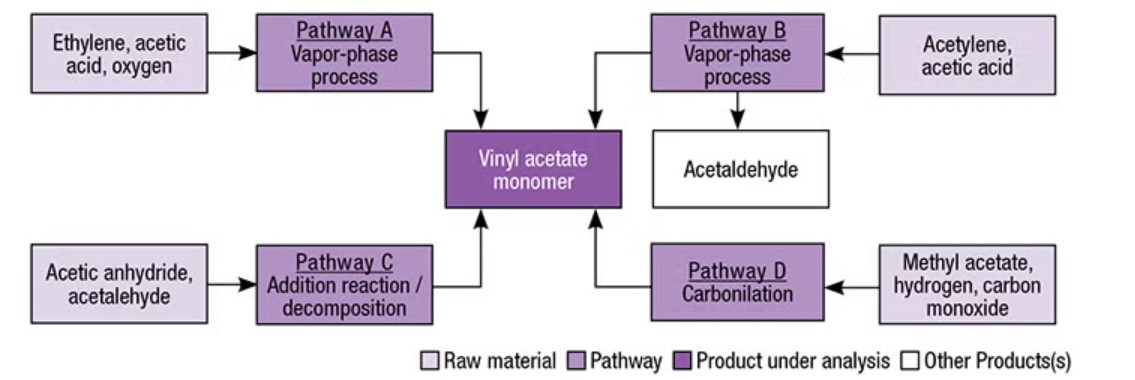
Vías de producción alternativas
Si bien la ruta del etileno-ácido acético es el referente para la producción económica a gran escala, la industria química utiliza rutas químicas alternativas basadas en las ventajas regionales de las materias primas y las fluctuaciones de sus precios.
Ruta del acetileno: Adición de ácido acético al acetileno (C2H2 + CH3COOH → VAM). Históricamente significativa y aún utilizada en regiones con abundantes reservas de carbón a bajo costo (que produce acetileno a través del carburo de calcio).
anhídrido acético Ruta del acetaldehído: Un proceso de varias etapas que implica la reacción del anhídrido acético con acetaldehído para formar diacetato de etilideno, que luego se craquea térmicamente para producir VAM.
Acetato de metilo Carbonilación de dimetil éter: Una ruta química C1 que utiliza gas de síntesis (CO + H2) para carbonilar acetato de metilo o dimetil éter. Esto proporciona una alternativa desvinculada de las cadenas de suministro tradicionales de petróleo/etileno.
Sitio web: www.elephchem.com
WhatsApp: (+)86 13851435272
Correo electrónico: admin@elephchem.com



 Soporta red IPv6